Legend of Mana: The Most Beautiful Watercolor Art on the PS1
Released by Squaresoft in 1999/2000, *Legend of Mana* builds its world piece by piece, features hand-painted artwork, and a soundtrack by Yoko Shimomura. It’s a cult classic that just keeps growing.
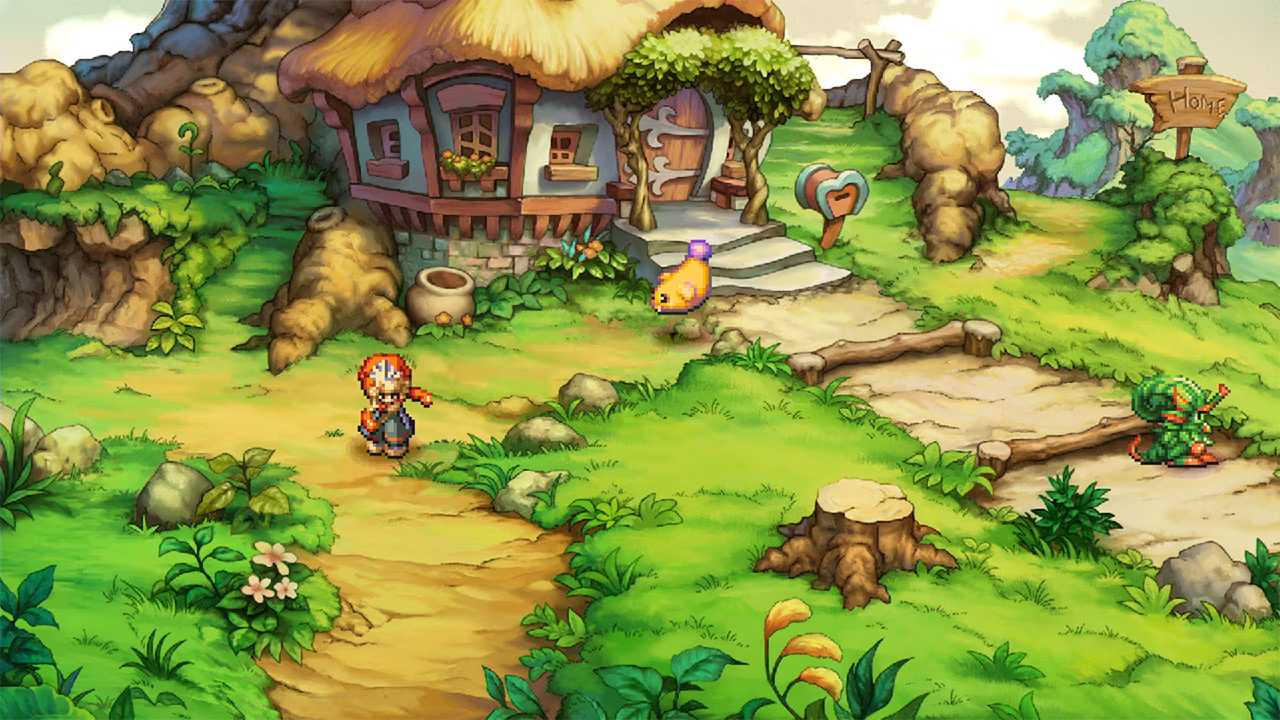
There are games we play, and there are games we live in. *Legend of Mana* is the latter. I popped the disc back in, almost 26 years after its Japanese release, and I still think this is the most beautiful RPG ever to grace the PlayStation 1. This isn’t nostalgic hyperbole: it really is watercolor, hand-painted, frame by frame. Let’s talk about this gem from Squaresoft.
Before it, Secret of Mana
To understand the magnitude of the leap, it’s worth remembering where the Mana series (Seiken Densetsu, in Japan) came from. The ultimate icon was 1993’s *Secret of Mana* on the Super Nintendo: an open-world action-RPG featuring the famous Ring Command system and, most legendarily, three-player co-op on the same screen. Then came Seiken Densetsu 3 (Trials of Mana), which was stuck in Japan for years. The series was synonymous with real-time combat, colorful fantasy, and the Mana Tree at the center of it all. When Koichi Ishii, the franchise’s creator, brought Mana to the PS1, he could have just done “more of the same.” He didn’t. He did something completely different.
Artwork That Still Takes Your Breath Away
The first thing that strikes you about Legend of Mana is the visuals. While half the world was chasing after polygonal 3D in 1999, Square opted for hand-painted 2D backgrounds, with a color palette that looks like an illustrated fairy tale book. Fa’Diel, the game’s world, is a place where every screen is a painting: forests in pastel hues, quirky and charming cities, golden deserts. The character sprites are large, expressive, and full of personality. Running on a PlayStation, it was pure magic. And best of all: because it’s stylized 2D, it has aged beautifully. While many polygonal RPGs from that era now look like a jumble of blocks, *Legend of Mana* remains stunning.
Land Make: You Build Your Own World
Here lies the game’s craziest and most brilliant idea. You don’t start with a pre-made world map. You build the world. The Land Make system works like this: the map starts out practically empty—a grid of blank spaces—and you place artifacts (items you acquire throughout the adventure) in those spaces to bring cities, dungeons, and regions into existence. Placing one artifact next to another even changes the Mana elements in that area, which affects enemies, items, and events. It’s the player who literally decides the geography of their own journey. I’ve never seen anything like it before or since, and this freedom to “paint” the map is central to its charm.
68 events, zero hand-holding
Land Make features the game’s boldest (and most divisive) structure: Legend of Mana doesn’t have a linear main story. The plot is spread across about 68 independent events/missions, and you discover them in whatever order you like—some may even be skipped depending on your choices. Amid this patchwork, three major story arcs stand out and lend emotional weight to the whole experience:
The Jumi Arc: the race of people with jewel-like hearts, hunted for their precious cores. It’s the fan-favorite arc, featuring Elazul, Pearl, and the villain Sandra. Moving and melancholic.
The Escad and Irwin (the fairies) Arc: four childhood friends caught in the conflict between humans and fairies, featuring Matilda, Irwin, Escad, and Daena. Their choices change the outcome.
The Dragons Arc (Drakonis): the dragoons Larc and Sierra, siblings serving dragon masters on opposite sides of a war for power.
Not having a hand on your shoulder telling you where to go bothered a lot of people in 2000. Today, that same openness is precisely what makes Fa’Diel such a personal place.
Action-RPG combat and the soundtrack by Yoko Shimomura
When it comes to combat, Legend of Mana stays true to the series’ spirit: real-time action combat on the same screen as exploration, with no transition to a separate arena. You control the hero and can bring up to two companions, chaining together attacks, special moves (Special Techs) charged via a meter, and even an absurdly deep weapon forging and customization system for those who love diving into menus. It’s fun, fluid, and rewards those who give it a try.
And then there’s the soundtrack. Yoko Shimomura—the same composer behind Kingdom Hearts and Street Fighter II—delivers one of the finest works of her career here. The opening theme alone is one of the most beautiful pieces in the history of video game music, period. It’s a collection of orchestral and ethereal tracks that perfectly match the game’s fairy-tale tone. It’s worth listening to even when you’re not playing.
Controversial at the time, a cult classic today
Upon its release, the game sold very well in Japan—400,000 copies in the first week alone. But critics were divided: everyone praised the hand-drawn graphics and the music, while at the same time turning up their noses at the lack of a clear central story, calling the experience “disjointed.” For a long time, it was that weird, misunderstood Mana game. Time, however, has been kind. Today, *Legend of Mana* enjoys absolute cult status, revered precisely for the qualities that scared people off in 2000: its strangeness, its freedom, and its dreamlike atmosphere.
The 2021 Remaster and Why You Should Play It
The good news is that today it’s easy to experience all of this. On June 24, 2021, Square Enix released the Legend of Mana remaster for Nintendo Switch, PS4, and PC (later also for mobile and Xbox), featuring reworked visuals, the option to disable random encounters, a card mini-game, and—the highlight— the reorchestrated soundtrack supervised by Shimomura herself. It tweaks what needed tweaking, respects what was already perfect, and makes the classic even more inviting.
Why play it? Because Legend of Mana isn’t about rushing to the end credits. It’s about wandering through a world you’ve designed yourself, collecting scattered stories that leave a lasting impression, listening to one of the best soundtracks of all time, and getting lost in a living watercolor painting. If you’re up for an RPG that swaps the straight path for a garden to explore at your own pace, this is one of the most special experiences the PS1 has given us. I still love every single screen in it.