Sonic Adventure: Sega's leap of faith into 3D
I went back to the original Dreamcast to replay Sonic Adventure (1998), the hedgehog's 3D debut. Between absurd speed, the Chao Garden and a treacherous camera, the Sonic Team classic still has plenty to say.
There are games you review and games you reunite with. Sonic Adventure, for me, is the second kind. I blew the dust off my original Dreamcast, heard that unmistakable little sound of the GD-ROM spinning up and, within seconds, there I was again in Station Square, December 1998 in Japan, heart racing. This review was done entirely on original hardware, with a Dreamcast controller in hand and the VMU beeping mid-game — because good retro is retro lived the way it was.
1998: the hedgehog bets it all on 3D
Context matters. In 1998, Sega was coming off a painful stumble with the Saturn and needed a miracle. The Dreamcast was that miracle — and Sonic Adventure, directed by Takashi Iizuka and produced by Yuji Naka, was the proof of concept. While Mario had already made his leap to 3D in 1996, Sega's mascot still didn't have a true three-dimensional platformer. The answer arrived on December 23, 1998 in Japan, alongside the newborn console, and on September 9, 1999 in the United States, as the flagship of the legendary 9/9/99 launch. In Europe, the game came out on October 14, 1999.
And what a calling card. Yuji Uekawa's redesign made Sonic taller, leaner and green-eyed — the modern look we still use today was born there. The bet paid off commercially: with around 2.5 million copies sold, Sonic Adventure became the best-selling game in Dreamcast history. The critics of the time also embraced the game: scores like GameSpot's 9.2 and IGN's 8.6 put the hedgehog back at the top of the conversation.
Six campaigns, six different games
The big idea of Sonic Adventure is that the story is a puzzle told from six points of view, each with its own gameplay. Replaying today, it's clear this is at once the game's greatest daring and its greatest Achilles' heel.
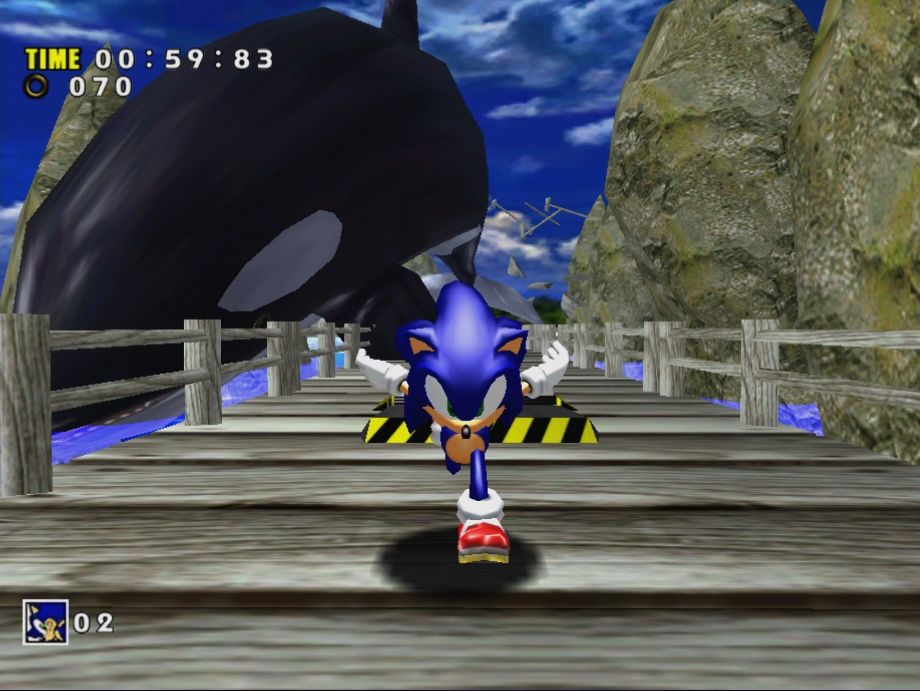
- Sonic is the main course: pure speed stages, the freshly invented homing attack, loops, the Emerald Coast orca chasing you down the pier. This is where the game sings. Speed Highway and Windy Valley are still thrilling in 2026.
- Tails turns the same stages into races against Sonic (or Eggman) using flight. Fun, short and light — almost an appetizer.
- Knuckles becomes a treasure hunt: finding three fragments of the Master Emerald in open arenas, with a radar. I loved it in 1999; today I find it ok, and you can see here the embryo of what Sonic Adventure 2 would later overdo.
- Amy is a slower, almost horror-like platformer, fleeing the robot ZERO with hammer in hand. Curiously charming, but her slowness clashes with the game's DNA.
- Big the Cat... look, I have affection for the big cat, but the fishing stages are indefensible. The rod physics are imprecise, the goal is to catch Froggy the frog, and the pacing simply dies. It's the part that aged worst — and, let's be honest, it was already strange back then.
- E-102 Gamma is the surprise: a lock-on shooter with a time limit and, on top of that, the most beautiful narrative arc in the game. An Eggman robot gaining consciousness in 1998? Sonic Team was ahead of its time.
The upshot of this variety: when the game gets it right (Sonic, Gamma), it's brilliant; when it gets it wrong (Big), you look at the clock. But you have to beat all six campaigns to unlock the final story with Perfect Chaos destroying Station Square — and that ending, with Super Sonic flying between flooded buildings, still gives me chills.
Gameplay and camera: genius speed, camera from hell
Let's address the elephant in the room. The sense of speed in Sonic Adventure is still great: the light-speed dash, the spin dash that works as both weapon and accelerator, the spectacular scripts like the collapsing building in Speed Highway. The Dreamcast controller, with its firm analog stick, responds better than affectionate memory suggests.
The camera, on the other hand, didn't get the same care from time. It locks behind walls, spins the wrong way on narrow platforms and, in speed sections, sometimes simply gives up on following you. The press of the era already complained — IGN pointed to the camera and frame rate drops as the package's big flaws — and playing today confirms it: a good chunk of my deaths weren't my fault, they were the camera's. Add to that the treacherous collisions (touch a wall at the wrong angle and you clip through the scenery) and we have a game that demands patience from anyone arriving in 2026 without nostalgia in their heart.
Chao Garden: the virtual daycare that stole my heart
If the campaigns are the body of the game, the Chao Garden is the soul. Raising those little blue blobs, feeding them animals rescued from the robots, watching them evolve according to the character you use... it's a Tamagotchi inside a platformer, decades before every game had a pet. And on the original Dreamcast there's a bonus the ports never reproduced properly: downloading your Chao to the VMU and carrying it in your pocket with the Chao Adventure minigame, raising the little creature in the bus line. In 2026, this remains one of the coolest ideas Sega ever had — and it explains why to this day people beg for a new Chao Garden with every Sonic announced.
Graphics: the 1998 generation shock
It's hard to explain to anyone who didn't live the impact of seeing Sonic Adventure running in a store in 1999. Coming from PlayStation and Nintendo 64, it looked like cheating: clean textures, huge environments, the Emerald Coast water shimmering, models with fingers and expressions. It was the first taste of the sixth generation, months before everyone else. Today, on a CRT (as the dress code demands), the game still has vibrant color and hugely inspired art direction — Station Square, Mystic Ruins and the Egg Carrier are places, not just stages. The facial animations of the cutscenes and the voice acting, on the other hand, aged like milk in the sun. It's part of the charm.
Soundtrack: Open Your Heart and the birth of Crush 40
No caveats here: the Sonic Adventure soundtrack is timeless. Jun Senoue took over musical direction and swapped the electronic pop of the classic games for hard rock guitars, with support from Fumie Kumatani, Kenichi Tokoi and Masaru Setsumaru. For the main theme, Open Your Heart, Senoue called in American vocalist Johnny Gioeli of the band Hardline — a partnership that would soon become Crush 40, the most iconic band in Sonic history. Each character has their theme (Big's little funk, Amy's ballad, Gamma's metal), each stage has its own identity, and Azure Blue World is playing in my head as I write this paragraph. It is, by far, the element that aged the least in the entire package.
Legacy and influence
Sonic Adventure defined modern Sonic: the character design, the homing attack, the more dramatic tone of the stories, the vocal themes, the explorable hub world. It got a direct sequel in 2001, was reissued as Sonic Adventure DX on GameCube and PC in 2003 and re-released in HD on Xbox 360 and PS3 in 2010 — versions that, ironically, received much lower scores, proof that part of the magic was in the context (and that the ports were lazy). Every 3D Sonic released since then, from Generations to Frontiers, converses with what Sonic Team attempted here. Few games carry so much DNA of an entire franchise.
Playing Sonic Adventure on the Dreamcast in 2026 is like seeing a childhood friend again: there are wrinkles, but the hug is still the same. Sonic's stages remain electrifying, the Chao Garden remains enchanting, the soundtrack remains perfect — and the camera remains terrible, Big remains unjustifiable and the bugs remain there, intact like fossils. If you accept the complete package, period defects and all, you find one of the most ambitious and charismatic games of its generation, the title that saved (for a time) Sega's soul. It's not the most polished 3D platformer of 1998, but it may be the bravest. And bravery, in the end, is what always defined the blue hedgehog.