Oracle of Ages and Oracle of Seasons: the two Zelda games for Game Boy Color that only made sense together.
Released in 2001 for Game Boy Color, the two Zelda games from Flagship connected via passwords, transforming two separate adventures into one.
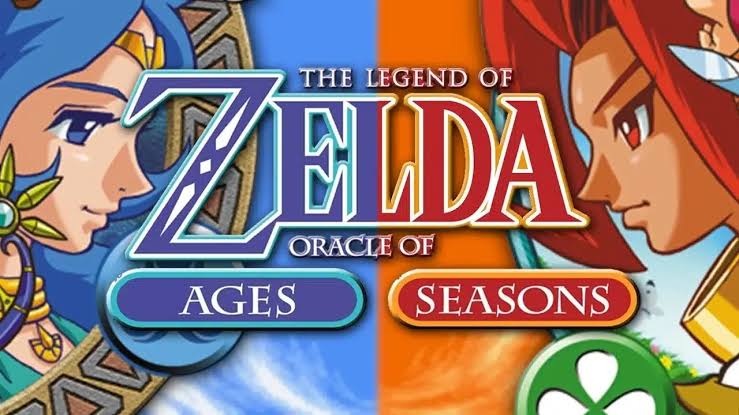
In 2001, when the Game Boy Color was already in its final months of prominence, Nintendo released two games from The Legend of Zelda series simultaneously: Oracle of Ages and Oracle of Seasons . They weren't a separate edition and its cosmetic variation, nor a game split in half. They were two complete adventures, with different worlds, central items, villains, and paces—and a password system that allowed the two to be woven together into a larger narrative.
Developed by Flagship , a subsidiary of Capcom , and published by Nintendo , the two titles arrived in Japan on February 27, 2001 , in North America on May 14, 2001 , and in Europe on October 5, 2001. Twenty-five years later, the pair remains one of the most daring structural experiments the franchise has ever attempted on a handheld console.
The twilight of the Game Boy Color
Context helps to understand the ambition of the project. The Game Boy Color was a short-lived console, squeezed between the gigantic legacy of the original Game Boy and the imminent arrival of a more powerful successor. Releasing two brand-new Zelda games at that time was both a farewell and a bet that there was still technical and creative space to explore on that hardware.
The project originated from a conversation between Yoshiki Okamoto , then head of Flagship, and Shigeru Miyamoto . After experimenting with the idea of bringing the original The Legend of Zelda to the Game Boy Color, the team began working on interconnected games that could be played in any order.
The initial plan was more ambitious than the final result: there were three games, not two. The complexity of tying everything together—especially due to the limitations of the password system used to connect the titles—forced the team to reduce the scope. The projects known as Mystical Seed of Power and Mystical Seed of Courage became Oracle of Seasons and Oracle of Ages , while the third chapter, Mystical Seed of Wisdom , was never completed.
In the credits, the duo brings together well-known names from the Japanese film industry: direction and screenplay by Hidemaro Fujibayashi , production by Noritaka Funamizu , art by Yusuke Nakano , and soundtrack by Minako Adachi and Kiyohiro Sada . Overall supervision was provided by Okamoto.
Oracle of Seasons: action, seasons, and the underground of Subrosia
Oracle of Seasons is the more straightforward of the two. The adventure takes place in Holodrum , a land threatened by Onox , the General of Darkness, and revolves around the Rod of Seasons —the staff that allows you to change the season on the screen where Link is standing. It's the game's central idea transformed into an exploration tool.
The mechanics change the map in concrete ways. In spring, flowers serve as a boost to reach higher areas; in summer, stream beds and lake bottoms become accessible; in autumn, fallen leaves open paths and mushrooms can be harvested; in winter, snow blocks trails and lakes freeze. The same scenario, therefore, has four possible interpretations.
To regain the power of the staff, Link needs to descend into Subrosia , an underground world filled with lava and inhabited by the Subrosians , hooded creatures who live oblivious to the surface. It is there that the Temple of the Seasons is located, sunk from Holodrum into the subsoil. Access is via portals scattered across the map, in a constant back-and-forth between the two planes.
The goal of the journey is to find the eight Essences of Nature , hidden in dungeons and protected by bosses, before the confrontation in Onox Castle. Critics at the time already pointed out the difference in emphasis between the two games: while Ages leans towards puzzles, Seasons relies more on combat and action.
Oracle of Ages: Time travel and puzzles in Labrynna
Oracle of Ages swaps the seasons for time. The setting is Labrynna , and the central item is the Harp of Ages , which allows Link to travel between the past and the present. The villain is Veran , the Sorceress of Shadows, and the essential collectible is the eight Essences of Time , also scattered throughout dungeons and guarded by bosses.
The structure is the same as Seasons, but the effect on the design is quite different. Altering something in the past permanently changes the present, which transforms a large part of the map into a puzzle of cause and effect. It's not enough to know where to go: you need to understand when to go, and what to change so that the route exists centuries later.
This penchant for puzzles gave Ages the reputation of being the more cerebral and, for many, the more difficult of the two. Dungeons that demand spatial reasoning across two timelines were a considerable undertaking for a portable screen of that size, which only reinforces the technical merit of what Flagship managed to squeeze onto the cartridge.
Both games also share the idea of choices that have repercussions. The most memorable example is that of the animal companions : Ricky , the boxing kangaroo, capable of leaping over cliffs and gaps; Moosh , the winged blue bear, who glides over gaps; and Dimitri , the swimming dodongo, who climbs rapids and waterfalls. In Seasons, Link rides all three throughout the story, but keeps only one; in Ages, he uses only one of them, in the Nuun Highlands.
The passwords that linked the two adventures
The big difference between the two games was what happened after the first ending. After finishing one game, the title generated a password that could be entered into the other, starting what was called a Linked Game — and the order was up to the player. Whoever started with Seasons could go straight to Ages , and vice versa.
The connected gameplay wasn't just a decorative bonus. Characters and enemies changed between the two titles, items could be upgraded or carried over from one adventure to the other, and previous choices were respected—the animal companion chosen in the first game, for example, reappeared in the second, even altering the shape of certain map regions, such as Natzu in Seasons and the Nuun Highlands in Ages. The ring system, which granted passive effects to Link, also benefited from this continuity.
Most importantly: only in the story-driven game did the story truly come to an end. It is in this game that the force acting behind the scenes of the two plots is revealed, culminating in the confrontation against Twinrova and against an incompletely resurrected Ganon . Zelda, whose sacrifice would complete the ritual, is freed by Link before this happens.
It is worth noting the historical caveat that accompanies the project to this day:
The third game in the series, Mystical Seed of Wisdom , was never finished. All speculation about how it would have worked, or about a supposed three-password system, is fan and press reconstruction—there is no released product to compare it to.
Reception, numbers, and the duo's legacy.
The strategy of releasing two games simultaneously was not without controversy. Some of the audience at the time compared the move to the dual-release model popularized by Pokémon , seeing it as an attempt to double sales. Critics, however, received both titles well, and the thematic division between action and puzzle ended up becoming the central argument in defense of the idea.
Commercially, the numbers speak for themselves: each game sold approximately 3.96 million units. There were also special editions—in Europe, a limited edition of 500 copies was released on May 21, 2001, combining the two games, a boomerang, a t-shirt, two pins, and two covers for Game Boy Color and Game Boy Advance. In North America, the first print run featured a metallic effect on the tree silhouette on the box and manual.
After the Oracles, the same team continued collaborating with Nintendo, this time formally under the Capcom brand, on A Link to the Past & Four Swords and, in 2004, on The Minish Cap . Flagship would eventually close, but its mark on the series remains evident to anyone who revisits these cartridges.
Anyone who wants to check them out today has legitimate ways to do so. Both games were re-released on the Nintendo 3DS Virtual Console in 2013 and, on July 27, 2023 , were added to the Nintendo Switch Online Game Boy Color catalog, with the password system preserved. To see original covers, artwork, and screenshots, as well as complete technical specifications, these references are helpful:
Played separately, Oracle of Ages and Oracle of Seasons would already be two good portable Zelda games. Played sequentially, with the password written down on a piece of paper — as many people did in 2001 — they become something else entirely: a rare experiment in two-part narrative, made for a console that was about to be phased out.