Sonic R: The Saturn's Most Beloved and Controversial Running Game
Released in 1997, Sonic R swapped karts for a running race on the Saturn. Flawed yet endearing, it achieved cult status thanks to Richard Jacques’s soundtrack and the Tails Doll creepypasta.
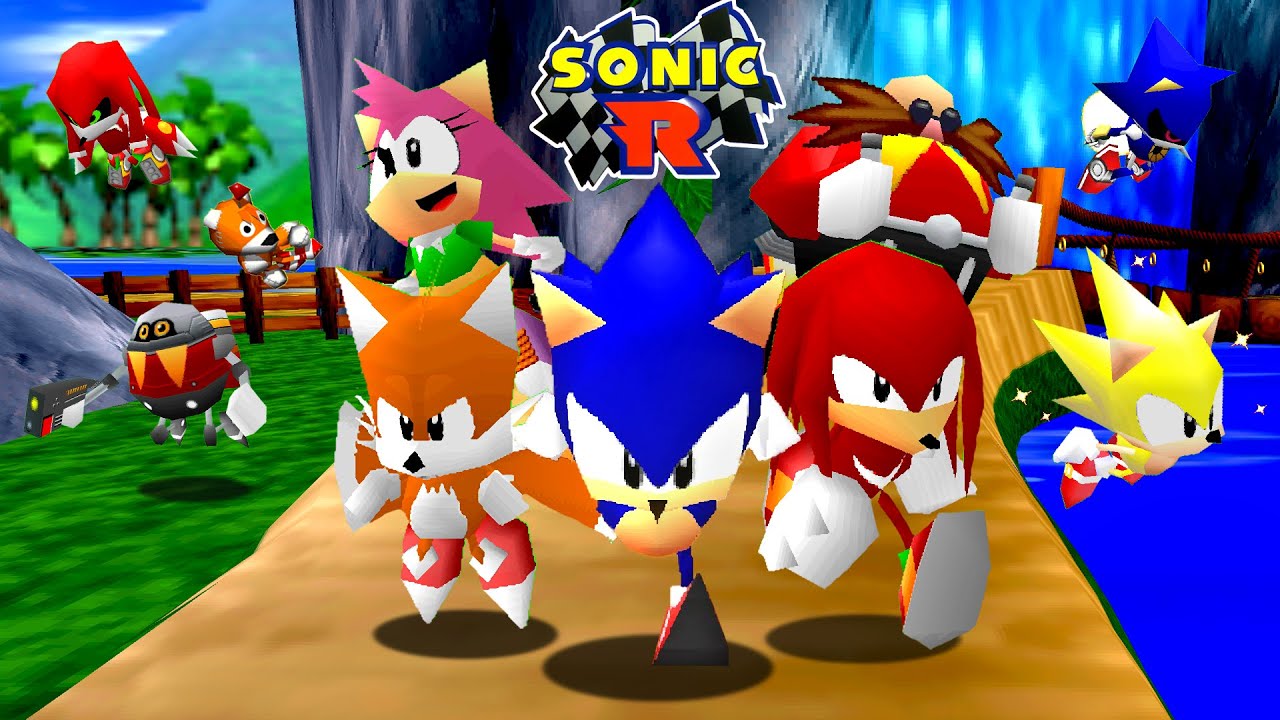
Let me confess something: I love Sonic R. I love it in a way I can’t even explain properly, because, I mean, the game is kind of glitchy. And yet, whenever I hear that “Can you feel the sunshine?”, I’m instantly transported back to 1997. Let’s talk about this weird and wonderful Sega Saturn classic.
A Sonic race… on foot?
Sonic R arrived on the Saturn in 1997, developed by Traveller’s Tales in partnership with Sonic Team and published by Sega. The central idea is both crazy and brilliant: instead of karts, like in Sonic Drift, here the characters run on their own two feet. It’s the third racing game in the franchise and the first fully in 3D.
The context helps explain the affection for it. The Saturn was a powerful console, but it lacked games featuring the blue mascot. While Mario had Super Mario 64 on the Nintendo 64, Sega struggled to deliver a major 3D Sonic title for its 32-bit console. Sonic R, even though it was “just” a racing game with five tracks, ended up becoming one of the defining titles of that somewhat turbulent generation.
Five tracks and a world to explore
There are exactly five tracks, and each has its own personality: Resort Island, the paradise beach that kicks off the game; Radical City, the neon metropolis; Regal Ruin, with its desert and Egyptian temple vibe; Reactive Factory, the massive industrial plant; and Radiant Emerald, the futuristic final track.
The brilliant detail is that the tracks aren’t linear corridors. They’re open-ended, full of alternative paths, ramps, hidden shortcuts, and secret areas. Chaos Emeralds and Sonic Tokens are scattered everywhere, and collecting them is half the fun. You don’t just race to finish first; you race to uncover every nook and cranny of that place. It’s practically an exploration game disguised as a racing game.
The Secrets and the Legend of Tails Doll
Talking about secrets in Sonic R means talking about the roster of unlockable characters. You start with Sonic, Tails, Knuckles, and Amy Rose, but the game hides a whole bunch of others: Metal Sonic, Egg Robo, Metal Knuckles, Dr. Robotnik himself, and the infamous Tails Doll. To unlock these metallic villains, you need to collect all five Sonic Tokens on a track, finish the race in the top three, and then defeat the character in a showdown.
And that brings us to the reason why so many people know about Sonic R without ever having played it: Tails Doll. It’s a little Tails stuffed animal with an antenna and a red orb on its head, floating around with a vacant smile and lifeless eyes. It’s genuinely unsettling. In the 2000s, the Tails Doll became one of the most famous creepypastas in the gaming community.
The urban legend claimed that if you unlocked the Tails Doll, played the song “Can You Feel the Sunshine?” and recited a ritual phrase (versions vary: in front of a mirror, with a second controller plugged in, in the dark…), the creature would come out of the screen to get you. “Can you feel the sunshine?” went from being a cheerful chorus to practically a code phrase for horror. It’s nonsense, of course. But it’s the kind of nonsense that guaranteed the game eternal life in the nerd imagination.
Slippery Controls: The Achilles’ Heel
Now, let’s be honest. Sonic R is divisive, and the main reason is the controls. The characters have absurd momentum; they slide like butter in a frying pan, and braking or making a sharp turn is a nightmare. You learn to anticipate every turn meters in advance, almost like driving a truck without brakes. A lot of people pick up the controller, slide down a slope straight into a wall, and quit the game within five minutes.
But once you master all that weight, something clicks. That same physics that seemed like a bug turns into a dance. Knowing how to use the ramps, cut through the water (some characters walk on it, others sink), and maintain top speed on the straights is deeply satisfying. It’s a game that punishes you for the first half-hour but rewards those who stick with it. It also helps that the total content is short: there are few tracks, and the replay value comes from hunting for secrets and exploring alternative modes, not from a long campaign.
3D graphics that were impressive on the Saturn
Visually, Sonic R is a feat. The Saturn had a reputation for giving 3D programmers a hard time, and yet Traveller’s Tales delivered colorful levels, full of water reflections, meticulously crafted textures, and a convincing sense of speed that ran smoothly. For 1997, on a console that struggled to render polygons, that was jaw-dropping. Even today, it has a delightful visual charm—part toy, part postcard.
The Soundtrack That Divides the World
And now we come to the heart of the controversy: the soundtrack by Richard Jacques, featuring vocals by British singer Teresa Jane Davis (TJ Davis). Forget the electronic beats of the classic Sonic games. Here we have vocal Eurodance pop, full of catchy choruses and upbeat lyrics: “Super Sonic Racing,” “Living in the City,” “Diamond in the Sky,” “Work It Out,” and, of course, the legendary “Can You Feel the Sunshine?”
There’s no middle ground. Either you think it’s the cheesiest, most out-of-place thing ever put in a racing game, or you sing along at the top of your lungs and consider it one of gaming’s greatest guilty pleasures. I’m on Team Two, without a shred of shame. Jacques wrote lyrics designed to match the on-screen action, and the result is as dated as it is unforgettable. No wonder “Super Sonic Racing” and “Can You Feel the Sunshine?” were reused in later games featuring the hedgehog.
Reception at the Time and Cult Legacy
At launch, critics were split. Average scores hovered around 69% on GameRankings for the Saturn version. Praise went to the visuals and the ingenious track design; criticism focused on the slippery controls, the difficulty, and the lack of content. It was a beautiful and ambitious game, but frustrating and too short to win over everyone.
Time, however, has been kind. Sonic R has become a cult classic. The Tails Doll creepypasta immortalized it, the soundtrack took on a life of its own in playlists and videos, and the concept of running on foot planted seeds that later blossomed in games like Sonic Riders. It went from being “that weird racing Sonic” to becoming a beloved cult classic.
Is it worth (re)discovering today?
Absolutely, but with the right mindset. Don’t go in expecting a sharp, competitive racing game; go in expecting a weird, slightly broken, absurdly charming time capsule. Give the controls those fifteen minutes of patience, let the soundtrack take over, and take your time hunting for secrets. Sonic R is flawed and beloved at the same time, and maybe that’s exactly why it endures. Just don’t stare at the Tails Doll for too long, okay? You never know.