The Mask on the Super Nintendo: The "Máskara" That Took Over the Video Rental Store
Released in 1995 for the SNES, *The Mask* became a huge hit at Brazilian video rental stores with its crazy Máskara, giant hammer, and merciless difficulty. Is it worth revisiting today?
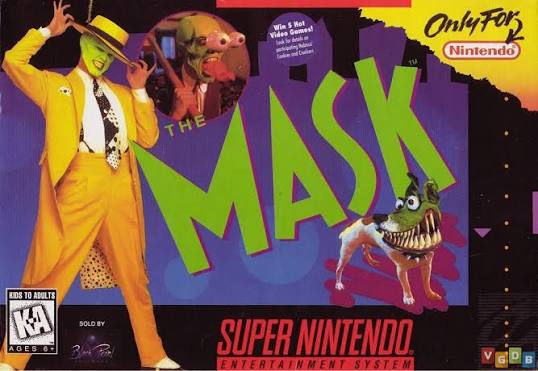
There are games we don’t remember for their sheer quality, but rather for the smell of the video rental store, the little box on the shelf, and the feeling of rushing home with the cartridge tucked under our arm. *The Mask*, or *O Máskara* as everyone called it, is exactly that kind of game. Based on the 1994 blockbuster starring Jim Carrey, it arrived on the Super Nintendo in October 1995 courtesy of Black Pearl Software, THQ’s label specializing in licensed adaptations. And, my friend, did I ever burn through those game tokens on it.
The *O Máskara* Craze and the Era of Movie Games
To understand the hype, you have to remember what The Mask was all about in the ’90s. Chuck Russell’s movie turned Jim Carrey into a global phenomenon: that green face, the bulging eyes, the yellow tuxedo, and the catchphrase “Somebody stop me!” were everywhere. There were T-shirts, trading cards, and cartoons. And, of course, there were video games, because in the 16-bit era, every blockbuster became a platformer. Aladdin, The Lion King, Jurassic Park, Batman: if it was a box-office hit, it got a game. The logic was simple and a little cynical, but it worked: kids would watch the movie, fall in love with it, and beg for the game. The Mask rode that wave beautifully.
Become the Mask: the crazy mechanics
The game’s biggest success was letting you truly be Máskara. Stanley Ipkiss started out normal, but when he put on the mask, he turned into that green, cartoonish fury full of moves straight out of Looney Tunes. The basic punch came with giant boxing gloves, but the real fun was in the special moves: the colossal hammer that crushed enemies like a crazed Woody Woodpecker, the spinning hurricane that swept across the screen, absurdly large weapons that appeared out of nowhere, and even a living horn to stun the henchmen.
All of this was governed by a clever detail: the mask’s energy meter (the “Morph Points”), a speedometer in the corner of the screen. Each move consumed energy, and when it ran out, you were left with just your fist until the meter recharged on its own. This forced you to pace yourself: you couldn’t just go around hammering everything; you had to save the tornado for the right moment. In addition to the fighting, Máskara could also run at supersonic speeds, become invisible, and sneak through ventilation ducts, because the levels were less like a race track and more like a maze to explore.
Six levels straight from the movie
The campaign took you through six settings that any fan of the movie would recognize instantly: Ipkiss’s apartment, the bank, the park, the prison, the nightclub, and the upscale neighborhood. Each was packed with visual references and that slapstick humor that made the movie work. The art direction captured the cartoonish tone very well, with exaggerated animations and that green face pulling crazy expressions with every hit. Technically, no one would say it was the pinnacle of the SNES—so much so that critics at the time took issue with the graphics for looking more like they were from 1993 than 1995—but the game’s charm more than made up for it.
Tough as nails, just the way it was back then
Now, let’s be honest: *The Mask* was a real challenge. And here comes the hallmark of the ’90s, when high difficulty wasn’t a philosophical “design choice”—it was a business model. The game had to be long and punishing to keep you hooked; otherwise, you’d beat it over the rental weekend and no one would rent it again. The maze-like level design only made things worse: it was easy to get lost looking for the exit, backtracking through the same ducts, and taking damage from enemies that kept respawning. Even critics at the time complained that the levels were too big and confusing. For us kids, though, this became a personal challenge: we’d go back to the video store, rent it again, and swear that this time we’d make it past the bank.
Why Brazil remembers it so fondly
Here’s the secret to Brazilian nostalgia: in 1990s Brazil, consoles and cartridges were ridiculously expensive. Almost no one bought new games; we rented them from the video rental store. And the video store was a world of its own: the shelf of cartridges, the registration slip, haggling with the owner to get two games for the price of one, and the Russian roulette of picking a title based solely on the cover. *The Mask* had a cover that screamed “take me home,” with Máskara flashing that huge grin. Add in the hype from the movie—which was constantly playing on *Sessão da Tarde* and at the VHS rental shops next door—and it was a surefire hit. A lot of people from my generation played *The Mask* without even finishing it, and yet it still left a lasting impression. It’s not the best platformer on the SNES, but it’s “ours” in a way that a game bought brand-new never could be.
Fun fact: the Mega Drive was left out
Here’s a detail few people know: there was a plan to release *The Mask* on the Mega Drive/Genesis as well, but the project was canceled. The Super Nintendo version took longer than expected to complete, and by the time it was set to launch, the rival console was already on the market—making it too late to capitalize on the momentum of the movie license. In other words: the gaming version of The Mask is a permanent exclusive to the gray Super Nintendo, and in Japan, it didn’t arrive there until late 1996.
Is it worth playing today?
It depends on what you’re looking for. If you’re after a polished, well-balanced, and modern platformer, there are better options. But if you enjoy hunting down relics, laughing at slapstick humor, and feeling that old-school thrill of difficulty, *The Mask* still delivers a fun afternoon—preferably with a save state handy so you don’t lose your cool in the maze. For those who lived through the era of video rental stores, it’s almost like a trip down memory lane: fire it up, grab the hammer, unleash the hurricane, and shout “Somebody stop me!” No one’s going to stop you, but the level design will try. And, honestly, that’s part of the fun.